
There's no question that a fuel pricing disaster is bearing down on travelers.
The situation, which was triggered by the U.S. attack on Iran in February, is terrible and getting worse.
Airfares in the United States have increased by 23.4% since August 2025, reports TravelPulse.
Executives at American Airlines, United Airlines, and Southwest Airlines have all said in recent days that skyrocketing fuel prices were pushing them to cancel routes that don't make enough money. That could mean that some shorter domestic flights will no longer be offered.
"As you look into the fourth quarter, there'll be some flights in December that we won't fly that we thought we were going to fly," the financial chief of United Airlines warned at an investors conference.
In Europe, the head of budget airline Ryanair warned passengers that cheap European flights may come to an end because of unrest in the oil-producing regions of the Middle East.
And that dire warning came before the national oil company of Saudi Arabia notified European refiners that it would receive no crude oil shipments next month.
Which leads to the essential question for travelers: How much are you willing to pay to fly?
How much did air travelers pay in the past?
Knowing the prices from the past can tell us something about how high airfares have been known to go.
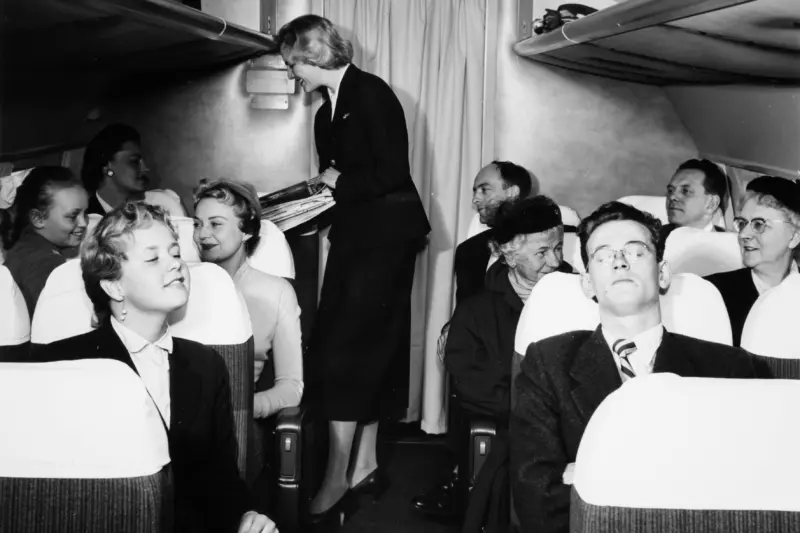
To put the current dramatic airfare hikes into historical perspective, let's look at the 1950s, when mainstream jet travel was born.
The introduction of jet planes marked the first time that average Americans had the ability to fly to Europe and back quickly enough to fit comfortably into the traditional U.S. vacation time of about 2 weeks. Before that, people had to rely on aircraft that fit only about 30 passengers, stopped multiple times for refueling, and required 25 hours or more to reach the destination. If travelers couldn't manage that, and the vast majority couldn't, they'd have to set aside up to a week in each direction to go by ocean liner.
Back in the 1950s, flying to Europe was a luxury that few people had experienced. So what did it cost them, and how does it compare to where airfares are today?
Fortunately, we have a record. Frommer's guidebooks were invented at the exact moment that jet travel opened to mainstream travelers. In fact, we essentially created our brand to inform the new, exploding middle-class market about the destinations they could now reach.
Our debut publication, Europe on 5 Dollars a Day, came out almost 70 years ago. It included a price chart for round-trip "excursion rates," which were airline tickets intended for tourists that could be paid in monthly installments.
Since airfare was set by the U.S. government's Civil Aeronautics Board or the International Air Transport Association to guarantee profits for the airlines (which were treated as a public utility), we know that these prices were fixed.
Let's compare 1957's airfares to the same prices, adjusted for inflation, in 2026 dollars.
• New York City–London: $425.00 ($5,066.42 in today's money)
• New York City–Paris: $461.00 ($5,495.58)
• New York City–Rome: $551.40 ($6,573.24)
• New York City–Athens: $686.00 ($8,177.80)
• New York City–Vienna: $535.40 ($6,382.50)
No wonder your grandparents decided to vacation in Daytona Beach instead!
By the 1961 edition of Europe on 5 Dollars a Day, the same routes cost:
• New York City–London: $486.00 ($5,444.83 in today's money)
• New York City–Paris: $525.60 ($5,888.48)
• New York City–Rome: $620.30 ($6,949.43)
• New York City–Athens: $756.00 ($8,469.73)
• New York City–Vienna: $601.90 ($6,743.29)
The 1969 edition of Europe on 5 Dollars a Day published these airfares for travel outside of peak summer:
• New York City–London: $399.00 ($3,641.88 in today's money)
• New York City–Paris: $440.80 ($4,023.41)
• New York City–Rome: $544.40 ($4,969.02)
• New York City–Athens: $690.90 ($6,306.20)
• New York City–Vienna: $526.30 ($4,803.81)
By 1980, right after deregulation in the U.S., New York City–London cost about $448.62 ($1,823.76 today).
By the 1990 edition, airfare had been deregulated but costs outside airline cabins had risen substantially so we were calling the same book Europe on $40 a Day.
The editors quoted airfares including "New York to London starting at $608 [$1,558.28 today] and to Paris at $619 [$1,586.48]." Most of the other airfares quoted from eastern U.S. cities to Europe were also in the $600–$700 ($1,537.78–$1,794.08) range.
How does that compare to prices right now?
Economy-class round-trip airfare going from New York City to Paris in mid-October 2026 will cost $897 to $953 on both Delta Air Lines and Air France. New York to London is similar: $894 to $962.
Or take domestic U.S. airfare between Los Angeles and Boston. Research by Compass Lexecon that was commissioned by Airlines for America found records of these airfares:
1978: $915.82 ($4,705.24 today)
2015: $408.89 ($577.89)
Which means we haven't yet reverted to how high airfare often was in the past—but we're inching toward that, and as fuel costs rise, the price of flying could begin challenging even the rates from distant memory.
As costs rise, airlines introduce monthly payment plans
As costs increase, the airlines are preparing for a market in which average Americans can no longer afford to purchase airfare in one payment.
We're seeing the gradual return of installment plans for paying down the cost of a trip.
Among the carriers that have recently instituted pay-by-the-month loan plans for vacations: American Airlines, Alaska Airlines, Delta Air Lines, Frontier Airlines, JetBlue, Southwest Airlines, and United Airlines.
Of course, that's only if a passenger's credit is good enough to be approved for the purchase.