
In an era when we can hold virtual meetings with colleagues and clients around the world without leaving our desks, is the business trip a dying tradition?
The answer appears to be no.
Sure, travel budgets are often constrained, and airfares and hotel rates keep ticking up, but people who are still willing to travel—when it counts—have the opportunity to gain the edge over competitors who might be taking a more penny-pinching approach.
“Employers should ask one question: What changes by being in the room?” suggests Phil Dickinson, vice president of sales at JA Resorts & Hotels. “If you’re simply sharing information, there’s a good chance you don’t need to travel. But if the outcome depends on trust, chemistry, negotiation, or experiencing something first-hand, the case becomes much stronger.”
And it turns out professionals agree. Recent research by the Global Business Travel Association, founded as an information-sharing hub for the community, found that 86% of business travelers still found work trips worthwhile.
In the United States, U.S. Travel reports business travel grew annually by 1.1% to $317 billion in 2025, and it's forecast to grow 0.7% in 2026 (in real terms) to $319 billion.
In the United Kingdom, a study conducted in early 2026 by corporate travel agency Travel Counsellors for Business revealed that 39% of small and medium-size businesses intend to increase international trips over the next 12 months.
Quality trips for quality results
It’s clear that business travel is still very much valued, but the type of soul-sapping, go-go-go travel portrayed in the 2009 George Clooney movie Up in the Air and in the Arthur Miller's 1949 classic play Death of a Salesman looks to be falling out of fashion.
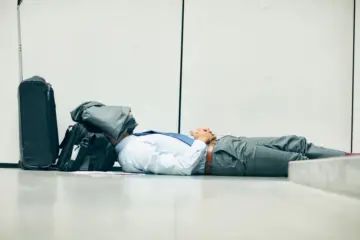
Today, many companies seem aware they'll have better results if employees traveling for work hit the ground running rather than arriving exhausted.
“More than ever, employers need to consider how ready people are to contribute when they arrive,” says Andrew Harrison-Chinn, CMO at Dragonpass, a membership company for travelers who use airport lounges. “Dragonpass’ research found that 27% of business travelers surveyed said they underperform because of travel stress,” said Harrison-Chinn. “A lower booking price is great, but it can lose its value if the itinerary leaves someone exhausted before an important meeting.
Harrison-Chinn highlighted the value of "sensible schedules, time to recover, and access to a suitable place to work."

The “bleisure” factor
More employees today insist on getting the most personal perks out of their trips, whether it’s by visiting nearby family and friends after they’ve attended client meetings, or wining and dining colleagues in the destination. The intentional balancing of business with pleasure during work trips has been termed bleisure within the travel industry.
A study carried out by marketing research organization Precedence Research found that 59% of Gen Z workers and 65% of millennial workers prioritize opportunities for blended travel when applying for jobs.
In the U.K., travel planning consultancy SAP Concur found that 22% of respondents would turn down a business trip if there was no ability to extend it to allow for personal travel.
This bleisure trend also means hotels need to review how they cater to business travelers.
“One of the biggest changes will be the continued blurring of business and leisure,” says Dickinson of JA Resorts & Hotels. “If somebody has flown several hours to Dubai for work, it increasingly makes sense to stay for the weekend rather than treating the destination purely as somewhere to have a meeting and leave. That creates an interesting challenge for hotels; on Friday they might need meeting facilities, connectivity, and a very efficient schedule. By Saturday they might want good restaurants and easy access to a great nearby beach.”
To satisfy their traveling employees, corporate travel bookers are also increasingly choosing hotels which serve multiple purposes, says Rebecca Hollants Van Loocke, chief operating officer EMEA at Frasers Hospitality. “Guest expectations are evolving beyond functionality. Local authenticity, wellness and cultural connection are increasingly important, particularly for longer stays, and employers know that travel agencies and hotels which can integrate local experiences and a sense of place into the stay can make business travel feel much more meaningful.”
A counter-pressure: sustainability
The number of business trips is increasing slightly, but for many companies, the justifications for travel are being scrutinized more carefully because of corporate sustainability goals.
“Business travel emissions now form part of many companies’ sustainability protocols and targets ,” explains Dr. Harald Zeiss, Professor of Tourism Management at Germany’s Harz University of Applied Sciences. “As a result, organizations are increasingly measuring emissions by route and mode of transport and incorporating that information into travel policies and approval systems. In practice, this can mean choosing rail where it is a viable alternative, taking direct flights, combining several meetings into one journey or selecting venues that are easy to reach by public transportation.”
But even green practices and goals don’t seem to be slowing down the number of business trips taken annually.
As more organizations conduct research into the value of business trips, that trend will likely increase.
Hospitality group Accor, which operates thousands of hotels worldwide, funded a study that showed that, on average, employees believe their ability to generate revenue increases by 36% when important meetings are conducted in person. According to that same study, 68% prefer to have client presentations in person.
Old school face time is, for now, clearly preferable to FaceTime.